
In search of the Aye-aye on Nosy Mangabe
Page 2
Rhett Butler
April 12, 2005
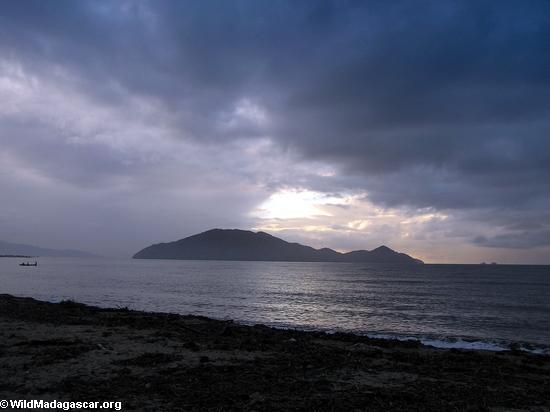 Sunset over Nosy Mangabe. Photo copyright Rhett A. Butler
 |
I arrive on Nosy Mangabe following a few of days on the Masoala Peninsula. The Masoala has Madagascar's largest protected tract of rainforest and accordingly, some the highest diversity of species on Earth. It is a beautiful area; the forest extending down to the long white sand beaches, and just offshore lie coral reefs and breeding grounds for humpback whales.
After setting up our tents, we spent the afternoon exploring Nosy Mangabe and observing some of the island's other wildlife. In addition to the nocturnal aye-aye, other lemurs on the island include the black-and-white ruffed lemur and the white-fronted brown lemur -- both of which are active during the day. Black-and-white lemurs are also found on the mainland of Madagascar, as far south as Ranomafana National Park. Strangely, despite the island's proximity to the Masoala peninsula, black-and-white lemurs are not found there. Instead they are replaced with the red ruffed lemur, a closely related, but genetically distinct lemur with dark red fur. Like the aye-aye, some mystery surrounds the black-and-white ruffed lemurs of Nosy Mangabe. No one is sure how long these lemurs have been on the island. Some believe they were introduced in the 1930s, but others point to reports from British indicating their presence as far back as the 17th century.
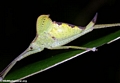
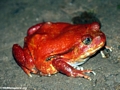
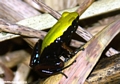
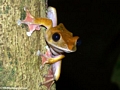
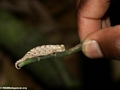
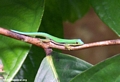
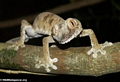
The forests of Nosy Mangabe are home to a spectacular array of other animals including divergent geckos, color-shifting chameleons, brightly-hued frogs, and a multitude of insects. Among the best-known of the island's creatures is the Uroplatus gecko, an animal so well-camouflaged that it disappears against the trunks of trees. It is difficult to believe that this cryptic lizard is in the same family as the neon green day geckos found on nearby palm trees around the island. Due to their remarkable characteristics, both these animals are highly sought in the pet trade. Overzealous collecting for the international reptile market has significantly reduced populations of some "herp" (reptile and amphibian) species in Madagascar. My local guide Armand comments that in the past, he has seen locals collecting reptiles and amphibians from Nosy Mangabe and protected areas on the Masoala peninsula.
| 
| 
|
Armand has been a guide in the Masoala region for over ten years -- before the peninsula was even designated as a national park. Over the years he has led dozens of dignitaries and world-renowned scientists through the rainforests and coral reefs of Masoala. Guiding is a well respected and well-paid occupation in Madagascar and for good reason -- ecotourism is one of the great hopes for the economic development of the country.
In Madagascar you are required to have a local guide when you enter a protected areas. This is to ensure both your safety and enjoyment of the surroundings as well as to provide employment opportunities for local people. Because the country is very poor, conservation efforts have a direct impact on local people who would otherwise use natural areas as a resource base for their everyday livelihood. As Masoala - The Eye of the Forest puts it "Everyone who lives on the Masoala peninsula lives directly from the use of natural resources. Almost no one at Masoala has the option, let alone the means, to become a lawyer, doctor, journalist, pilot, bus-driver, secretary, mechanic or librarian, let alone to aspire to a leisurely retirement. Average life expectancy in Madagascar is about 56 years. Everyone's survival strategy is therefore centered in one way or another around natural resource use." Therefore, providing economic incentives for local people is a key to making conservation successful in Madagascar. Ecotourism may be the best way for local people to directly benefit from protected areas while maintaining protection.
Ecotourism is indeed growing in Madagascar. According to the Bradt guide to Madagascar around 50% of visitors to the country now visit a protected area when they visit the country (up from 20% in 1995). Responsibly managed ecotourism can generate substantial amounts of revenue and employ large numbers of local people without causing significant environmental damage. And because ecotourists pay to see a country's natural beauty, local people are motivated to conserve the environment around them. Ecotourism can help assign value to an ecosystem and most ecotourists are willing to pay directly for preservation in the form of park entrance fees and the hiring of local guides.
In Madagascar, local communities benefit directly from ecotourism through their 50% share of park entrance fees (park entry fees are divided equally between the national parks service, ANGAP, and local communities), sales of handicrafts and "tourist items," and employment as porters, wildlife guides, park rangers, workers in the service force of hotels, restaurants and lodges. The guide training programs implemented by ANGAP helps the local community as a whole through the education of its members. With an education and a understanding of multiple languages, the future holds increased opportunities for Malagasy children.
Education also helps conservation efforts in a region where there is often a lack of communication with outlying communities. In the early days of Masoala, people in these remote areas did not know what they could and could not do within the boundaries of the park. Lemur hunting, illegal tree felling, and other activities continued not necessarily out of malice towards the park but as a result of ignorance. Today, park managers rely on radio broadcasts to reach outer communities to explain regulations concerning the park as well as convey both the importance and uniqueness of the Masoala. With an understanding that the wildlife around them is found only in their backyard and that foreigners are willing to pay unimaginable sums of money and travel incredible distances just to see these creatures, locals are instilled with a sense of pride in their native fauna. The realization of the economic potential of their surroundings helps cement the importance of maintaining a healthy forest.
NOSY MANGABE CONTINUED...
page 1 | page 2 | page 3
Nosy Mangabe | Masoala