
Madagascar | Conservation | Maps | Wildlife | Photos | Search | Help | Forum | About
ISALO NATIONAL PARK
Isalo index | Isalo pictures | Isalo journal | Parks index

Isalo

Province: Toliary (Tuléar)

Area: 81,540

Protected area status: National park

Year established:

General location: 22°22 and 22°40 southern latitude / 45°11 and 45°23 longitude

Location and Access: 683 km southwest of Antananarivo, 279 km southwest Fianarantsoa, 243 km northeast of Toliara.

Climate: Dry tropical forest and savanna

Average temperature: 17-25°C

Elevation: 820 to 1240 m

Precipitation: 85 cm

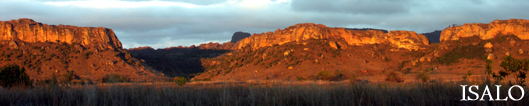
Description: Isalo's landscape consists of eroded ruiniform sandstone formations dating to the Jurassic period, deep canyons with riparian forests, palm-lined oases, fire-resistant tapia forests, and open grasslands.

FAUNA
Birds: 82
Reptiles: 33
Frogs: 15
Mammals: 14

Lemur species 14:

FLORA:
Isalo is known for its pachypodes (Pachypodium ), aloe and euphorbiums.

The following vegetation zones are found in the park:
  • Riparian forest found along rivers in the canyons of Isalo
  • Scattered sclerophyle forest made up of fire-resistant Tapia (Uapaca bojeri) and Heza (Astropeia micraster)
  • Rupicolous vegetation found on rocky surfaces and consisting of Pachypodiums (Pachypodium geayi, Pachypodium willlamarai, Pachypodium rosulatum, Pachypodium horombese, and Pachypodium densiflorum); Aloes (Aloe acutissima, Aloe isalensis and Aloe detoideodonta); and a species of Kalanchoes
  • Dry forest on alluvial deposits.
    Families: 99
    Species: 340

    Dominant ethnic group(s): Bara

    Official web page

    Additional notes: 238 of the plant species in Isalo are endemic

    Journal:
    Part I
    Part II

    Video:
    Video from Isalo

    MAP/Satellite Picture


    PHOTOS


    Isalo sunset


    Verreaux's sifaka in Isalo


    Rice paddies near Canyon des Makis and Canyon des Rats


    Oustalet's chameleon walking across sand near Isalo


    Mascarene Ridged Frog (Ptychadena mascareniensis)


    Bismarck Palm (Bismarckia nobilis) at sunset


    Ranohira King's pool


    Furcifer oustaleti chameleon (light brown)


    Furcifer oustaleti chameleon (juvenile-bright green)


    Green-blue swallow-tail butterfly


    Raspberry dragonfly


    Rice paddies near Canyon des Makis and Canyon des Rats


    Ring-tailed lemur (Lemur catta) standing on its hind legs


    Family of ring-tail lemurs (including babies)


    Flatid leaf bugs (Phromnia rosea)


    Oustalet's chameleon walking across sand near Isalo


    Boophis goudoti frog in Isalo (Isalo)


    Adult Flatid leaf bugs (Phromnia rosea)


    Blue dragonfly


    Canyon des singes


    Ring-tailed lemur (Lemur catta)


    Madagascar giant chameleon (Furcifer oustaleti)


    Isalo sunset


    Oustalet's chameleon in a Plumeria tree


    Verreaux's sifaka in Isalo


    Rosy Periwinkle


    Fire-resistant Bismarck Palms (Bismarckia nobilis) near Isalo


    Canyon des Singes in Isalo NP (Isalo)


    Canyon des Singes in Isalo NP (Isalo)


    Ranohira Falls (Isalo)


    Piscine Naturelle pool (Isalo)


    Bright green Furcifer oustaleti chameleon (Isalo)


    Raspberry dragonfly


    Oustalet's chameleon walking across sand near Isalo


    Isalo National Park landscape (Isalo)


    Canyon des Singes in Isalo NP (Isalo)


    Canyon des Singes in Isalo NP (Isalo)


    Madagascar Wagtail (Motacilla flaviventris)


    Canyon des rats in Isalo NP (Isalo)


    Isalo (Isalo)


    Aerial view of deforestation and erosion in southern Madagascar (Isalo)


    Isalo National Park at sunrise (Isalo)


    Approaching storm at sunset in Isalo (Isalo)


    Malagasy grasslands (Isalo)


    Dung beetles (Isalo)


    Ranohira Falls (Isalo)


    Walking stick insect


    Isalo (Isalo)


    Elephant's foot plant (Isalo)


    Piscine Naturelle (Isalo)


    Furcifer oustaleti chameleon (juvenile-bright green)


    Isalo sunrise (Isalo)


    Mother ring-tailed lemur with young in Isalo National Park (Isalo)


    Isalo stream with palms and sandy substrate (Isalo)


    King's pool in Canyon des Makis


    Isalo National Park landscape (Isalo)


    Straw-like grasshopper


    Phromnia rosea (fuschia colored insects) (Isalo)


    Approaching storm at sunset in Isalo (Isalo)


    Queen of Isalo, a rock formation like profile of a sitting queen


    Isalo National Park at sunrise (Isalo)


    Surf off southern Madagascar (Ft. Dauphin)


    Canyon des Singes in Isalo NP (Isalo)


    Gray Boophis goudoti frog in Isalo (Isalo)


    Canyon des Singes in Isalo NP (Isalo)


    Rosy Periwinkle


    Furcifer oustaleti chameleon (juvenile-bright green)


    Canyon des rats in Isalo NP (Isalo)


    Isalo sunrise (Isalo)


    Furcifer oustaleti chameleon (juvenile-bright green)


    Bismarck Palm (Bismarckia nobilis) at sunset


    Isalo sunset


    Bara father and daughter near Isalo (Isalo)


    Isalo oasis (Isalo)


    Isalo National Park landscape (Isalo)


    Canyon des Singes in Isalo NP (Isalo)


    Sunset in Isalo National Park (Isalo)


    Canyon des Singes in Isalo NP (Isalo)


    Isalo (Isalo)


    Sunrise over Isalo National Park (Isalo)


    Green caterpillar


    Fire-resistant Bismarck Palms (Bismarckia nobilis) near Isalo


    Canyon des Singes in Isalo NP (Isalo)


    Distant rain at sunset in Isalo National Park (Isalo)


    Mother ring-tailed lemur with baby in Isalo N.P. (Isalo)


    Frog


    Bright green Furcifer oustaleti chameleon near Isalo (Isalo)


    Canyon des Singes in Isalo NP (Isalo)


    Aerial view of Ranohira village near Isalo (Isalo)


    Canyon des Singes in Isalo NP (Isalo)


    Beaches of southern Madagascar (Ft. Dauphin)


    Rock formation in Isalo (Isalo)


    Isalo massif: Canyon des Makis and Canyon des Rats


    Canyon des rats in Isalo NP (Isalo)


    Savanna near Isalo (Isalo)


    Isalo Massif at sunset


    -->

    Pictures on this site were taken with a Konica Minolta


  • WILDMADAGASCAR.ORG
    WildMadagascar.org aims to raise interest in Madagascar, a land of cultural and biological richness

    Madagascar
    Madagascar Pictures
    Madagascar News
    People of Madagascar
    About the site
    Educational materials
    Help Madagascar
    In French


    SUPPORT
    You can help support wildmadagascar.org by using this link to buy from Amazon.com.


    Beautifully illustrated with full color photographs throughout, Madagascar Wildlife is a celebration of the unique fauna of a remarkable island and the perfect accompaniment to Bradt's popular general travel guide, Madagascar.


    RECENT NEWS

    Caution urged in sale of Madagascar's illegal timber stockpiles

    (02/03/2012) Confiscated timber stocks in Madagascar must be managed in a "transparent manner" to deter future illegal logging and boosting demand for endangered rainforest timber, says a letter published by a coalition of NGOs.


    Photos of the day: a celebration of wetlands (for World Wetlands Day)

    (02/02/2012) Forget the groundhogs, February 2nd is also World Wetland Day, commemorating the historic convention of wetlands in Ramsar, Iran in 1971. The Ramsar Treaty was an international agreement meant to address the loss and degradation of wetlands worldwide.


    Frog perfume? Madagascar frogs communicate via airborne pheromones

    (01/25/2012) Researchers have found that some frogs in Madagascar communicate by more than just sound and sight: they create distinct airborne pheromones, which are secreted chemicals used for communicating with others. A paper published in Angewandte Chemie International Edition relates that some male members of the Mantellinae family in Madagascar use large glands on their inner thighs to produce airborne pheromones. Interestingly, the pheromones are structurally similar to those produced by insects. Scientists have identified frogs producing water-borne pheromones before, but this is the first instance of airborne.


    Featured video: music in Madagascar to protest illegal logging

    (01/22/2012) A new video highlights the plight of Madagascar's protected tropical forests, which are falling prey to illegal logging and foreign contractors. Featuring Razia Said, Malagasy singer and songwriter, the video shows concerts to raise awareness about illegal logging, especially near Maosala National Park.


    National Association of Music Merchants does 'disservice' to members by misleading them on illegal logging law, says letter

    (01/19/2012) The National Association of Music Merchants is doing a 'disservice' to its members by misrepresenting the provisions and spirit of the Lacey Act, a law that aims to curb illegal logging abroad, states a letter published by a coalition of environmental groups. The letter, issued Thursday, urges the National Association of Music Merchants to reconsider its support for the RELIEF Act (HR 3210), introduced by Representatives Marsha Blackburn (R-TN), Mary Bono Mack (R-CA), and Jim Cooper (D-TN) last October. The RELIEF Act would weaken key provisions of the Lacey Act aimed to ensure that illegally sourced wood products aren't imported into the United States.


    How lemurs fight climate change

    (01/09/2012) Kara Moses may have never become a biologist if not for a coin toss. The coin, which came up heads and decided Moses' direction in college, has led her on a sinuous path from studying lemurs in captivity to environmental writing, and back to lemurs, only this time tracking them in their natural habitat. Her recent research on ruffed lemurs is attracting attention for documenting the seed dispersal capabilities of Critically Endangered ruffed lemurs as well as theorizing connections between Madagascar's lemurs and the carbon storage capacity of its forests. Focusing on the black-and-white ruffed lemur's (Varecia variegata) ecological role as a seed disperser—animals that play a major role in spreading a plant's seeds far-and-wide—Moses suggests that not only do the lemurs disperse key tree species, but they could be instrumental in dispersing big species that store large amounts of carbon.


    Photo: Tiny lemur discovered in Madagascar forest

    (01/08/2012) A new species of mouse lemur has been discovered in eastern Madagascar, report researchers from Germany. The species is described in a recent issue of the journal Primates.


    Cultural shifts in Madagascar drive lemur-killing

    (12/15/2011) Conservationists have often found that some cultural norms, religious beliefs, and taboos play a role in holding back traditional peoples from overusing their environment. Examples of such beliefs include days wherein one cannot hunt or fish, or certain species or regions that are off limits to exploitation. But the influence of the modern world can rapidly extinguish such beliefs, sometimes for the better, in other cases not. In many parts of Madagascar, lemurs are off the menu. These primates, found only in Madagascar, play a big role in Malagasy 'fady' or taboo-related folk stories: lemurs are protectors and, in some cases, even relatives. However, according to a new paper in PLoS ONE an influx of migrants, widespread poverty, lack domestic meat, and poor law enforcement has caused a sudden rise in eating lemurs, many of which are already near-extinction due to habitat loss.


    Madagascar tree diversity among the highest worldwide

    (12/12/2011) In terms of biodiversity, the hugely imperiled forests of Madagascar may be among the world's richest. Researchers estimate that the island off the coast of Africa is home to at least 10,000 tree and shrub species with over 90 percent of them found no-where else in the world. With little baseline data collected on Madagascar's ecosystems, a new study, the first ever of tree diversity in Madagascar lowland rainforests, hopes to begin the process. Published in mongabay.com's open access journal Tropical Conservation Science, the new study surveyed tree species in eastern Madagascar's Betampona Special Reserve.


    Forgoing bushmeat hunting has health toll in Madagascar, says study

    (11/22/2011) Conservationists shouldn't overlook the detrimental health impacts of shifting local populations away from subsistence bushmeat hunting, says a new study.


    More news

    GEAR

  • Madagascar Wildlife T-shirt
  • Dancing lemurs T-shirt
  • Madagascar Chameleons Calendar
  • Madagascar wildlife bag


  • home | photos index | search | about | contact

    Unless otherwise noted, all content and images are the property of Rhett Butler, content copyright 2004-2008.
    All rights reserved.