Hypogeomys antimena - Madagascar Giant Jumping Rat
Madagascar is home to an assortment of bizarre animals from lemurs to hedgehog-like tenrecs to brightly colored geckos. Due to its geographic isolation, about three-fourths of its species are found nowhere else on the planet and the island lacks many of the animals found elsewhere in the world. Naturally absent from Madagascar are dogs, rabbits, cats, monkeys, squirrels, pangolins, toads, monitor lizards; adders, vipers, cobras, pythons, hornbills, woodpeckers, and a host of other animals you might expect to find due to their prevalence in regions near the island. In their place, vacant ecological niches are filled by uniquely native Malagasy species. Among these species is the Giant Jumping Rat (Hypogeomys antimena), an animal that can be compared to a rabbit both in terms of its appearance and its role in the ecosystem.
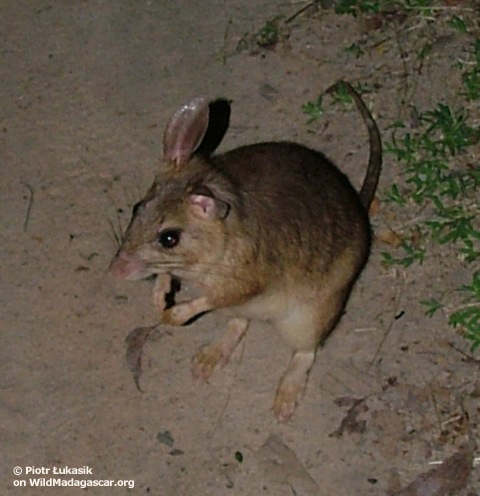
The giant jumping rat is the largest rodent in Madagascar, roughly equivalent in size to a rabbit. Also like a rabbit, the giant jumping rat has long pointed ears, short fur and large rear feet which are used for jumping. The giant jumping rat can leap almost three feet (one meter) into the air to avoid predators -- namely the puma-like fossa which is actually related to the mongoose and the Madagascar ground boa. The rat's normal mode of movement is walking, like in most other rodents.
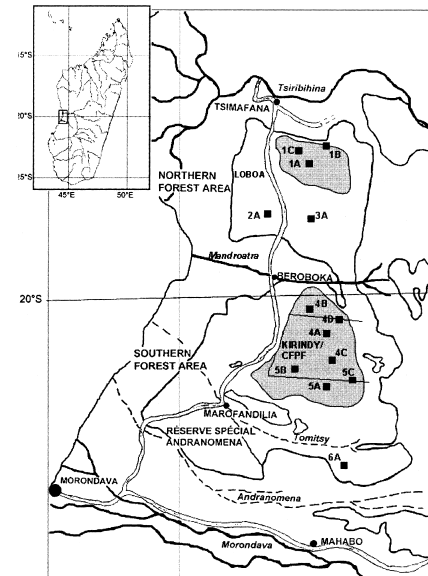
Giant jumping rats are found in the dry deciduous forests of western Madagascar, especially around the town of Morondava. According to Animal Conservation 2002 (vol.5:263-273), "the modern distribution of H. antimena has been reduced recently to a fragmented area of suitable habitat within a geographic range of less than 20 � 40 km north of the town of Morondava near the western coast of
Madagascar. The remaining population is divided into two subpopulations." Perhaps the best place to see these creatures is at Kirindy, a protected area with tourist facilities located about two hours from Morondava. Kirindy doubles as a research center; one which has uncovered much of what we know about this species.
Extensive burrows
Again, like rabbits, giant jumping rats live in burrows. These typically consist of a complex of tunnels, each around 18 inches (45 cm) in diameter, up to 17 feet (5 meters) long and a yard (one meter) underground. A family unit, consisting of a monogamous pair and offspring, generally lives in a burrow and maintains a territory covering 7-10 acres (3-4 hectares) -- although this expands in the dry seasons when food is scarce.
Nocturnal, giant jumping rats leave their burrow at dusk to feed on fallen fruit and seeds. Food is consumed in a manner similar to squirrels whereby it is held in the forepaws and manipulated in the mouth while the rat sits semi-upright on its haunches.
A species on the brink
 If you are interested in contributing to the conservation efforts of the Durrell Wildlife Conservation Trust, please visit their web site at giant jumping rat and other species in Madagascar. Donations can be made 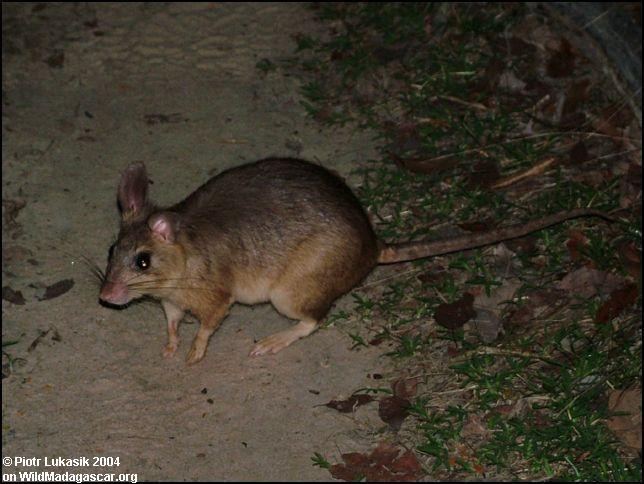 Giant jumping rat at Kirindy (Photo by Piotr Lukasik)
 CLICK HERE to make comments, add a link, or submit content for
Cheirogaleus adipicaudatus CLICK HERE to make comments, add a link, or submit content for
Cheirogaleus adipicaudatus
|

<br><br>
</td>
</tr>
</table-->
According to the Durrell Wildlife Conservation Trust, a nonprofit dedicated to the protection of Madagascar's unique species, in the wild giant jumping rats are born at the start of the warm rainy season in late November and early December. A litter generally consists of one or two young who stay with their parents for varying amounts of time depending on their sex; 2 to 3 years for female offspring and 1 to 2 years for young males. In captivity giant jumping rats have life expectancy of 5 years.
<br><br>
Like many animals in Madagascar, giant jumping rats are highly endangered due to habitat loss and predation from introduced species. Currently listed on the World Conservation Union (IUCN) Red List for endangered species, the population is estimated at around 11,000. According to the Durrell Wildlife Conservation Trust, in May 2001 a computer modeling technique, called a Population Habitat Viability Analysis, )

<br><br>
<br><br>
<a href=)